Insights
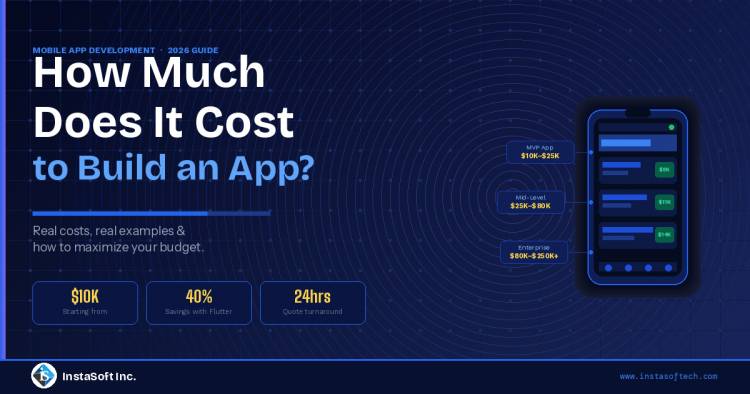
How Much Does It Cost to Build a Mobile App in 2026?
If you're a founder or business owner with a mobile app idea, the first question on your mind is almost always: "How much is this going to cost me?"
The honest answer? It depends. But in this guide, we'll break down exactly what drives mobile app costs in 2026, what you can realistically expect to pay, and how to get the most value for your budget.
The Short Answer
| App Type | Estimated Cost |
|---|---|
| Simple / MVP App | $10,000 – $25,000 |
| Mid-Complexity App | $25,000 – $80,000 |
| Complex / Enterprise App | $80,000 – $250,000+ |
These are ballpark figures. Let's break down what puts you in each category.
What Factors Determine the Cost?
1. App Complexity
This is the biggest cost driver. The more features, the higher the cost.
Simple apps include:
- Basic UI with 4–6 screens
- User login / registration
- Simple data display
- Push notifications
Complex apps include:
- Real-time features (chat, live tracking)
- Payment gateway integration
- Third-party API integrations
- Admin dashboard
- AI or machine learning features
- Multi-language support
2. Platform — iOS, Android or Both?
- Single platform (iOS or Android only): Lower cost
- Cross-platform (Flutter or React Native): Build once, run on both — best value in 2026
- Native for both (Swift + Kotlin): Highest quality, highest cost
At InstaSoft, we recommend Flutter for most startups — it delivers near-native performance at cross-platform cost.
3. Design Complexity
A basic UI with a standard template costs far less than a custom, pixel-perfect design system. If your brand experience matters (and it should), budget for good design.
4. Backend & Infrastructure
Most apps need a backend — a server, database and APIs that power your app.
- Simple backend (Firebase, Supabase): Low cost, fast to build
- Custom backend (Node.js, Python, etc.): More flexible, higher cost
- Cloud infrastructure (AWS, Google Cloud): Ongoing monthly cost to factor in
5. Who Builds It — And Where?
This is where costs vary the most:
| Development Team Type | Hourly Rate |
|---|---|
| US / UK Freelancer | $100 – $200/hr |
| US / UK Agency | $150 – $300/hr |
| Eastern Europe Agency | $50 – $100/hr |
| India-based Agency (low quality) | $15 – $30/hr |
| India-based Agency (premium, US-standard) | $35 – $70/hr |
At InstaSoft, we operate with a US headquarters (Irving, Texas) and a world-class development center in Chennai, India — giving our clients US-standard quality at a fraction of the cost.
Real Cost Examples in 2026
Example 1: Food Delivery MVP — $18,000
- Customer app (iOS + Android via Flutter)
- Restaurant listing and menu
- Cart and Stripe payment integration
- Order tracking (basic)
- Admin panel
Example 2: Healthcare Appointment App — $45,000
- Patient and doctor portals
- Appointment scheduling
- Video consultation (WebRTC)
- Medical records storage
- HIPAA compliance considerations
- Push notifications and reminders
Example 3: SaaS Mobile Companion App — $90,000
- Complex dashboard
- Real-time data sync
- Role-based access control
- Third-party integrations (Salesforce, HubSpot)
- Custom analytics
Hidden Costs Founders Often Miss
Before you finalize your budget, make sure you've accounted for:
- App Store fees — Apple charges $99/year, Google charges a one-time $25
- Third-party services — Payment gateways, SMS APIs, maps, push notification services
- Maintenance & updates — Budget 15–20% of development cost annually
- QA & Testing — Often overlooked, critical for launch quality
- Post-launch iterations — Real users always find things to improve
How to Reduce Costs Without Cutting Quality
Start with an MVP
Don't build everything at once. Launch with your core feature set, get real user feedback, then iterate. This is how the best startups in the US and GCC operate.
Choose Cross-Platform (Flutter)
Flutter lets you build for iOS and Android simultaneously — cutting your development time and cost by up to 40%.
Pick the Right Partner
The cheapest option is rarely the best value. A team that communicates well, delivers on time and writes clean code will save you far more money in the long run than a cheap team that disappears after launch.
Why Startups Across US, GCC & UK Choose InstaSoft
At InstaSoft, we've spent 10 years building mobile apps for startups and businesses across the United States, Gulf region and United Kingdom.
- ? US-headquartered — Irving, Texas
- ? Transparent, fixed-price project quotes
- ? Flutter, React Native, iOS & Android experts
- ? Dedicated project manager for every client
- ? On-time delivery track record
- ? Post-launch support included
We understand that every dollar matters when you're building a product. That's why we work as a true partner — not just a vendor.
Ready to Get a Quote for Your App?
Stop guessing. Tell us about your app idea and we'll give you a detailed, transparent quote within 24 hours — no fluff, no hidden costs.
Get a Free Quote → www.instasoftech.com/get-quote
???? +1 267 666-0024 ???? www.instasoftech.com
InstaSoft Inc. is a US-based custom software development company specializing in mobile apps, web platforms, AI solutions and eCommerce development. Serving clients across the US, GCC, UK and beyond since 2016.
How Much Does It Cost to Build a Mobile App in 2026?
If you're a founder or business owner with a mobile app idea, the first question on your mind is almost always: "How much is this going to cost me?"
The honest answer? It depends. But in this guide, we'll break down exactly what drives mobile app costs in 2026, what you can realistically expect to pay, and how to get the most value for your budget.
The Short Answer
| App Type | Estimated Cost |
|---|---|
| Simple / MVP App | $10,000 – $25,000 |
| Mid-Complexity App | $25,000 – $80,000 |
| Complex / Enterprise App | $80,000 – $250,000+ |
These are ballpark figures. Let's break down what puts you in each category.
What Factors Determine the Cost?
1. App Complexity
This is the biggest cost driver. The more features, the higher the cost.
Simple apps include:
- Basic UI with 4–6 screens
- User login / registration
- Simple data display
- Push notifications
Complex apps include:
- Real-time features (chat, live tracking)
- Payment gateway integration
- Third-party API integrations
- Admin dashboard
- AI or machine learning features
- Multi-language support
2. Platform — iOS, Android or Both?
- Single platform (iOS or Android only): Lower cost
- Cross-platform (Flutter or React Native): Build once, run on both — best value in 2026
- Native for both (Swift + Kotlin): Highest quality, highest cost
At InstaSoft, we recommend Flutter for most startups — it delivers near-native performance at cross-platform cost.
3. Design Complexity
A basic UI with a standard template costs far less than a custom, pixel-perfect design system. If your brand experience matters (and it should), budget for good design.
4. Backend & Infrastructure
Most apps need a backend — a server, database and APIs that power your app.
- Simple backend (Firebase, Supabase): Low cost, fast to build
- Custom backend (Node.js, Python, etc.): More flexible, higher cost
- Cloud infrastructure (AWS, Google Cloud): Ongoing monthly cost to factor in
5. Who Builds It — And Where?
This is where costs vary the most:
| Development Team Type | Hourly Rate |
|---|---|
| US / UK Freelancer | $100 – $200/hr |
| US / UK Agency | $150 – $300/hr |
| Eastern Europe Agency | $50 – $100/hr |
| India-based Agency (low quality) | $15 – $30/hr |
| India-based Agency (premium, US-standard) | $35 – $70/hr |
At InstaSoft, we operate with a US headquarters (Irving, Texas) and a world-class development center in Chennai, India — giving our clients US-standard quality at a fraction of the cost.
Real Cost Examples in 2026
Example 1: Food Delivery MVP — $18,000
- Customer app (iOS + Android via Flutter)
- Restaurant listing and menu
- Cart and Stripe payment integration
- Order tracking (basic)
- Admin panel
Example 2: Healthcare Appointment App — $45,000
- Patient and doctor portals
- Appointment scheduling
- Video consultation (WebRTC)
- Medical records storage
- HIPAA compliance considerations
- Push notifications and reminders
Example 3: SaaS Mobile Companion App — $90,000
- Complex dashboard
- Real-time data sync
- Role-based access control
- Third-party integrations (Salesforce, HubSpot)
- Custom analytics
Hidden Costs Founders Often Miss
Before you finalize your budget, make sure you've accounted for:
- App Store fees — Apple charges $99/year, Google charges a one-time $25
- Third-party services — Payment gateways, SMS APIs, maps, push notification services
- Maintenance & updates — Budget 15–20% of development cost annually
- QA & Testing — Often overlooked, critical for launch quality
- Post-launch iterations — Real users always find things to improve
How to Reduce Costs Without Cutting Quality
Start with an MVP
Don't build everything at once. Launch with your core feature set, get real user feedback, then iterate. This is how the best startups in the US and GCC operate.
Choose Cross-Platform (Flutter)
Flutter lets you build for iOS and Android simultaneously — cutting your development time and cost by up to 40%.
Pick the Right Partner
The cheapest option is rarely the best value. A team that communicates well, delivers on time and writes clean code will save you far more money in the long run than a cheap team that disappears after launch.
Why Startups Across US, GCC & UK Choose InstaSoft
At InstaSoft, we've spent 10 years building mobile apps for startups and businesses across the United States, Gulf region and United Kingdom.
- ? US-headquartered — Irving, Texas
- ? Transparent, fixed-price project quotes
- ? Flutter, React Native, iOS & Android experts
- ? Dedicated project manager for every client
- ? On-time delivery track record
- ? Post-launch support included
We understand that every dollar matters when you're building a product. That's why we work as a true partner — not just a vendor.
Ready to Get a Quote for Your App?
Stop guessing. Tell us about your app idea and we'll give you a detailed, transparent quote within 24 hours — no fluff, no hidden costs.
Get a Free Quote → www.instasoftech.com/get-quote
???? +1 267 666-0024 ???? www.instasoftech.com
InstaSoft Inc. is a US-based custom software development company specializing in mobile apps, web platforms, AI solutions and eCommerce development. Serving clients across the US, GCC, UK and beyond since 2016.

5 Technology Trends Every Business Should Watch in 2025
The technology landscape is evolving faster than ever—and businesses that want to stay ahead need to understand and adapt to the latest trends. Whether you're running a startup, a mid-sized company, or a large enterprise, keeping your tech stack updated isn't just an advantage anymore—it's a necessity.
Here are five technology trends in 2025 that are reshaping industries across the globe:
1. AI-Powered Automation
AI is moving beyond chatbots and data analysis. In 2025, businesses are increasingly adopting AI to streamline operations, handle customer support, predict trends, and even write code. Companies leveraging AI tools are saving time, cutting costs, and improving customer experiences.
What You Can Do: Start small—integrate AI into customer service or automate internal workflows.
2. Hyper-Personalization in Marketing
With data and AI, businesses can now deliver highly personalized experiences to their customers. Personalized emails, product suggestions, and landing pages are driving more engagement and sales than generic campaigns.
Tip: Use behavior data and AI tools to segment your audience and craft tailored messaging.
3. Cloud-Native Applications
Modern businesses are shifting toward cloud-native apps that offer scalability, flexibility, and cost efficiency. Technologies like Kubernetes, Docker, and serverless architectures are becoming the new norm.
Why it Matters: Cloud-native solutions reduce infrastructure headaches and improve deployment speeds.
4. Cybersecurity as a Top Priority
With cyberattacks growing more sophisticated, investing in cybersecurity is no longer optional. Expect to see a rise in Zero Trust Architecture and AI-powered threat detection systems.
Takeaway: Don’t wait for an attack—audit your systems, encrypt data, and train your team.
5. Low-Code/No-Code Development
Speed is everything in today’s digital world. Low-code platforms allow businesses to create apps faster, test ideas, and reduce dependency on developers—perfect for startups and internal tools.
Use Case: Automate repetitive tasks or create internal dashboards without hiring a full dev team.
Final Thoughts
The businesses that adapt quickly to technological changes are the ones that thrive. By embracing trends like AI, cloud-native apps, and low-code development, you're not just staying relevant—you're creating a competitive edge.
At Instasoft Inc, we specialize in helping businesses harness these technologies to innovate faster, streamline operations, and grow smarter. From custom software development to AI automation and cloud solutions, we’ve got the expertise to guide your digital transformation journey.
Let’s talk about your business goals. Contact Instasoft today for a free consultation.